Billy McKee
Say NothingBilly McKee was a veteran Irish republican and hard-line leader whose challenge to the Irish Republican Army leadership in 1969 helped set the movement on the path to a split. A legendary figure to the young Brendan Hughes, McKee joined a tradition of republican militancy but also embodied its turn from political disagreement to armed confrontation.
Identity and Republican Formation
Born in 1921, only months after the partition of Ireland, McKee joined the Irish Republican Army’s youth wing at fifteen. He had spent time behind bars in every decade since, a record that made him a veteran of repeated cycles of republican activism and imprisonment. A devout Catholic, he attended Mass every day and carried a gun at all times. The account presents these traits together: religious observance and armed commitment were not opposing parts of his public identity.
The Cyprus Street Challenge
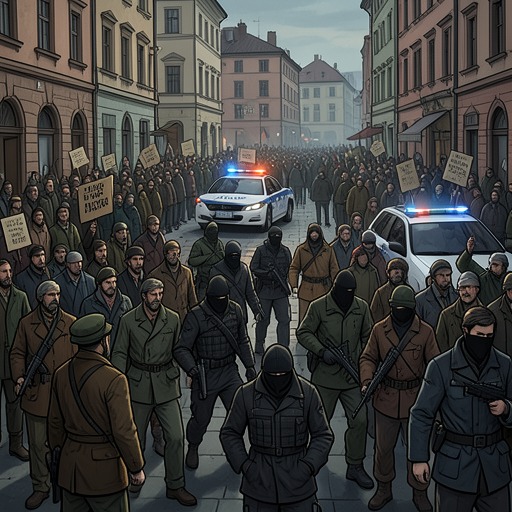
In September 1969, following riots in which the Irish Republican Army had failed to protect Catholic communities, commander Liam McMillen convened a leadership meeting in a room on Cyprus Street. McMillen was widely blamed for that failure. McKee led twenty-one armed men into the meeting and directly challenged his authority: “You are a Dublin communist and we are voting you out,” he told McMillen. “You are no longer our leader.” The intervention made the dispute more than an argument over strategy: an armed faction was attempting to remove the existing leadership by force.
By early 1970, a breakaway organization had formed as the Provisional IRA, committed to armed resistance, while the older organization became known as the Official IRA. The split sharpened divisions within republicanism even as both wings fought loyalist groups, the Royal Ulster Constabulary, and the British Army. McKee’s role in the leadership confrontation places him at a decisive point in that realignment; the account identifies him as one of the hard-line figures who helped establish the Provisionals.
McKee and Brendan Hughes
McKee’s influence also appears in Brendan Hughes’s childhood, before Hughes became involved in the armed struggle himself. Hughes’s father had been a member of the Irish Republican Army in his youth, and one of his father’s friends was McKee. The family revered him as a patriot and gunman. On Sunday walks to Mass, they passed McKee’s house on McDonnell Street, which Hughes approached with a feeling of reverence.
After a funeral, Hughes once spotted McKee talking with adults in a scullery where tea was being made. Hughes deliberately brushed against him and felt the .45 beneath his belt. He asked to see the weapon, and McKee showed it to him. The encounter gives McKee’s legendary status a concrete, intimate form: to a boy raised in a republican household, the revered figure was also the armed man close enough to touch, and willing to let him see the gun.